
CardForge White Paper
The Future of Card Collecting: Where AI Meets Blockchain in an Epic Adventure
Abstract
Welcome to CardForge, the ultimate quest for card collectors! Imagine a world where your favorite trading cards are protected by super-smart AI detectives and locked in an unbreakable treasure chest powered by blockchain magic. CardForge is not just an app—it's your personal card guardian, marketplace, and gaming arena all rolled into one epic adventure.
Whether you're a kid opening your first pack or a seasoned collector with thousands of cards, CardForge makes collecting fun, fair, and futuristic. Say goodbye to fake cards, confusing values, and boring storage. Say hello to instant grading, AR battles, and a vibrant community where every card tells a story!
Introduction: The Future of Cards
Think of CardForge as your superhero sidekick in the card-collecting universe. Our AI is like a smart detective with X-ray vision—it can spot fake cards faster than you can say "holographic Charizard!" Our blockchain is like an indestructible treasure chest that keeps your cards safe and proves you're the real owner.
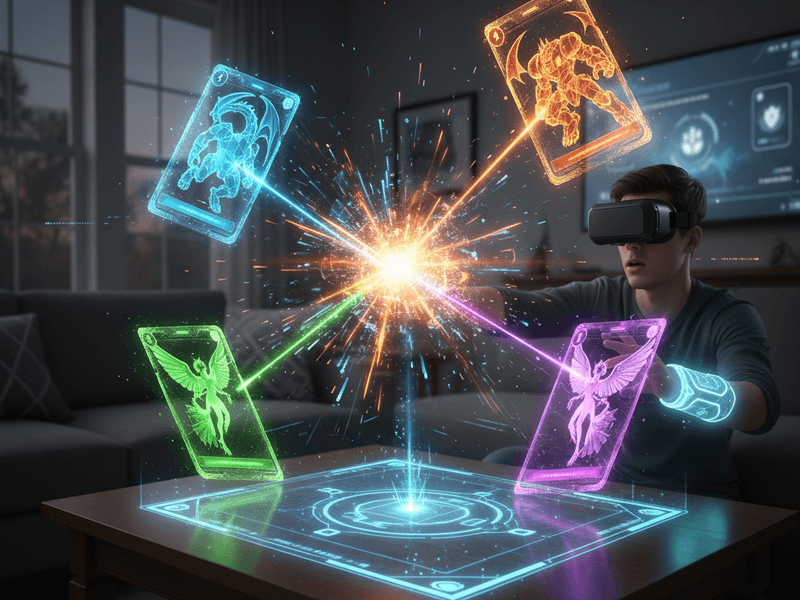
But we didn't stop there. CardForge is also a gaming platform where you can battle friends with AR (Augmented Reality), trade cards in a bustling marketplace, and earn rewards just for being awesome. It's like Pokémon GO meets eBay meets a digital vault—all in your pocket!
Problems in the Card World
Let's face it: collecting cards today can be frustrating. Here are the big bad bosses we're fighting:
🎭 Fake Cards Everywhere
Counterfeit cards flood the market. Without expert knowledge, it's hard to tell real from fake.
⏰ Grading Takes Forever
Sending cards to grading companies can take months. Who has time for that?
💰 Unclear Values
Card prices change daily. It's tough to know if you're getting a fair deal.
😴 Boring Storage
Cards sit in binders collecting dust. Where's the fun in that?
Solution Overview: CardForge to the Rescue!
CardForge swoops in with four superpowers to save the day:
AI Fake Detection
Our AI scans your card in seconds and tells you if it's real or fake. It's trained on millions of cards and gets smarter every day!
Blockchain-Secured Ownership
Every card gets a digital twin (NFT) stored on the blockchain. It's like a birth certificate that can never be forged or lost.
Instant Grading
Get a grade (1-10) for your card's condition in under a minute. No more waiting months!
Social & Gaming Layer
Trade, battle, and show off your collection. Join tournaments, earn rewards, and make friends!
Technology Stack: The Magic Behind CardForge
Let's peek under the hood and see how CardForge works its magic. Don't worry—we'll keep it fun and simple!
AI & Computer Vision
Our AI is powered by Convolutional Neural Networks (CNNs)—fancy words for "super-smart pattern detectors." When you scan a card, the AI looks at tiny details like print quality, holographic patterns, and color accuracy. It compares your card to millions of real cards in its database and gives you a verdict: real or fake!
How It Works (Kid-Friendly Version):
- You take a photo of your card with your phone
- The AI detective examines every pixel
- It checks for clues: Is the hologram shiny enough? Are the colors right?
- It gives you a score and tells you if it's authentic
import tensorflow as tf
from tensorflow.keras import layers, models

# Build a simple CNN for card authenticity detection
def create_card_scanner_model():
    model = models.Sequential([
        # Input layer: Card image (224x224 RGB)
        layers.Conv2D(32, (3, 3), activation='relu', input_shape=(224, 224, 3)),
        layers.MaxPooling2D((2, 2)),

        # Hidden layers: Extract features
        layers.Conv2D(64, (3, 3), activation='relu'),
        layers.MaxPooling2D((2, 2)),

        layers.Conv2D(128, (3, 3), activation='relu'),
        layers.MaxPooling2D((2, 2)),

        # Flatten and classify
        layers.Flatten(),
        layers.Dense(128, activation='relu'),
        layers.Dropout(0.5),

        # Output: Real (1) or Fake (0)
        layers.Dense(1, activation='sigmoid')
    ])

    model.compile(
        optimizer='adam',
        loss='binary_crossentropy',
        metrics=['accuracy']
    )

    return model

# Train the model
model = create_card_scanner_model()
# model.fit(training_data, training_labels, epochs=50)

# Predict authenticity
def scan_card(image):
    prediction = model.predict(image)
    return "Real Card! ✅" if prediction > 0.5 else "Fake Card! ⚠️"
Mathematical Encoding Engine
At the heart of CardForge lies our revolutionary Mathematical Encoding Engine—a system that transforms physical cards into unique digital fingerprints. Think of it as creating a DNA sequence for each card, where every pixel, color, and imperfection becomes part of its immutable blockchain identity.
The Encoding Process:
- Divide the card image into a grid of pixel-density blocks
- Compute color histograms for each spatial region
- Analyze density scores based on pixel intensity patterns
- Detect and quantify flaws, scratches, and imperfections
- Generate a unique codex hash representing the card's mathematical identity
- Store the codex as an immutable blockchain record
import numpy as np
from PIL import Image
import hashlib

def analyze_pixel_block(image_array, x, y, block_size=64):
    """
    Analyze a pixel block and compute density and flaw scores.

    Args:
        image_array: NumPy array of the card image
        x, y: Block position coordinates
        block_size: Size of each block in pixels

    Returns:
        Dictionary with block analysis data
    """
    # Extract the pixel block
    block = image_array[
        y*block_size:(y+1)*block_size,
        x*block_size:(x+1)*block_size
    ]

    # Compute color histogram (RGB channels)
    hist_r = np.histogram(block[:,:,0], bins=256)[0]
    hist_g = np.histogram(block[:,:,1], bins=256)[0]
    hist_b = np.histogram(block[:,:,2], bins=256)[0]

    # Calculate density score (high-intensity pixel count)
    density_score = np.sum(block > 200) / block.size

    # Detect flaws (sudden color changes, scratches)
    edges = np.abs(np.diff(block.astype(float), axis=0))
    flaw_score = np.sum(edges > 50) / edges.size

    return {
        'position': (x, y),
        'color_histogram': {
            'r': hist_r.tolist(),
            'g': hist_g.tolist(),
            'b': hist_b.tolist()
        },
        'density_score': float(density_score),
        'flaw_score': float(flaw_score)
    }

def create_card_codex(image_path, grid_size=4):
    """
    Create a complete codex for a card image.

    Args:
        image_path: Path to the card image
        grid_size: Number of blocks per dimension

    Returns:
        Complete codex dictionary
    """
    # Load and prepare image
    img = Image.open(image_path).convert('RGB')
    img_array = np.array(img)

    # Analyze all blocks
    blocks = []
    total_density = 0
    total_flaw = 0

    for y in range(grid_size):
        for x in range(grid_size):
            block_data = analyze_pixel_block(img_array, x, y)
            blocks.append(block_data)
            total_density += block_data['density_score']
            total_flaw += block_data['flaw_score']

    # Generate unique hash
    codex_string = f"{image_path}{total_density}{total_flaw}"
    codex_hash = hashlib.sha256(codex_string.encode()).hexdigest()

    return {
        'card_id': 'BABE_RUTH_GENESIS_1914',
        'codex_hash': codex_hash,
        'encoded_blocks': blocks,
        'overall_density': total_density,
        'total_flaw_score': total_flaw,
        'ai_grade': max(1, min(10, 10 - (total_flaw * 100)))
    }

# Example usage
codex = create_card_codex('babe_ruth_genesis.jpg')
print(f"Codex Hash: {codex['codex_hash']}")
print(f"AI Grade: {codex['ai_grade']:.1f}/10")
Interactive Genesis Card Encoder
Experience the mathematical encoding engine in action with the legendary Babe Ruth Genesis Card. This interactive demonstration shows how pixel-density analysis, color histograms, and flaw detection combine to create an immutable blockchain identity.
Experience the mathematical encoding engine in action. Watch as the legendary Babe Ruth Genesis Card is transformed into an immutable blockchain identity through pixel-density analysis and AI-assisted grading.
Interactive Simulation Demo
Watch the complete encoding and blockchain registration process unfold in real-time! This interactive simulation demonstrates every stage of the CardForge mathematical encoding engine, from initial card scanning through final blockchain lock.
What You'll See:
- Card Scanner Animation: Watch the Babe Ruth Genesis Card slide through the scanner
- Real-Time Math Panels: See equations for pixel density, flaw detection, and code compression
- AI Grading Network: Visual representation of neural network processing each pixel block
- Codex Generation: Witness the creation of the card's unique mathematical fingerprint
- Blockchain Lock: Final registration and immutable storage confirmation
Watch the Babe Ruth Genesis Card go through the complete mathematical encoding and blockchain registration process in real-time.
Blockchain: The Unbreakable Treasure Chest
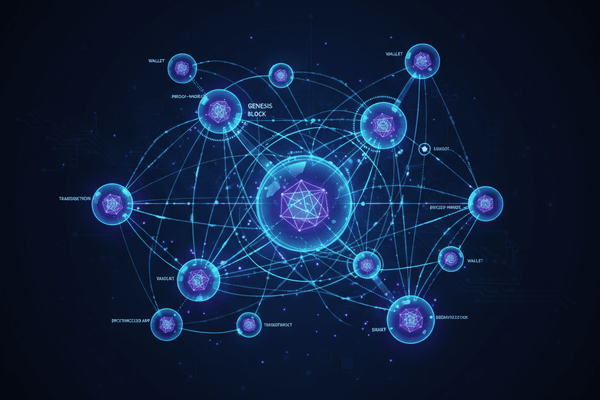
Think of blockchain as a magical ledger that everyone can see but no one can cheat. When you register a card on CardForge, we create a Non-Fungible Token (NFT)—a unique digital certificate that proves you own that specific card.
We use Ethereum Layer 2 or Solana for fast, cheap transactions. Your card's data (grade, authenticity, ownership history) is locked on the blockchain forever. Even if CardForge disappeared tomorrow, your proof of ownership would remain!
// SPDX-License-Identifier: MIT
pragma solidity ^0.8.20;

import "@openzeppelin/contracts/token/ERC721/ERC721.sol";
import "@openzeppelin/contracts/access/Ownable.sol";

contract CardForgeNFT is ERC721, Ownable {
    uint256 private _tokenIdCounter;

    struct CardData {
        string cardName;
        string cardSet;
        uint8 grade;           // 1-10 condition grade
        bool isAuthentic;      // AI verification result
        uint256 mintTimestamp;
        string imageURI;
        bytes32 codexHash;     // Mathematical encoding fingerprint
    }

    mapping(uint256 => CardData) public cardRegistry;

    event CardMinted(
        uint256 indexed tokenId,
        address indexed owner,
        string cardName,
        uint8 grade,
        bytes32 codexHash
    );

    constructor() ERC721("CardForge", "CARD") Ownable(msg.sender) {}

    function mintCard(
        address to,
        string memory cardName,
        string memory cardSet,
        uint8 grade,
        bool isAuthentic,
        string memory imageURI,
        bytes32 codexHash
    ) public onlyOwner returns (uint256) {
        require(grade >= 1 && grade <= 10, "Grade must be 1-10");
        require(isAuthentic, "Only authentic cards can be minted");

        uint256 tokenId = _tokenIdCounter;
        _tokenIdCounter++;

        _safeMint(to, tokenId);

        cardRegistry[tokenId] = CardData({
            cardName: cardName,
            cardSet: cardSet,
            grade: grade,
            isAuthentic: isAuthentic,
            mintTimestamp: block.timestamp,
            imageURI: imageURI,
            codexHash: codexHash
        });

        emit CardMinted(tokenId, to, cardName, grade, codexHash);

        return tokenId;
    }

    function getCardData(uint256 tokenId) public view returns (CardData memory) {
        require(ownerOf(tokenId) != address(0), "Card does not exist");
        return cardRegistry[tokenId];
    }

    function verifyCodex(uint256 tokenId, bytes32 codexHash) public view returns (bool) {
        return cardRegistry[tokenId].codexHash == codexHash;
    }
}
Integration: Connecting AI to Blockchain
Here's where the magic happens: when you scan a card, the AI analyzes it and sends the results to the blockchain. The smart contract then mints an NFT with all the card's data. It's like a relay race where AI passes the baton to blockchain!
import { useState } from 'react';
import Web3 from 'web3';
import { Button } from '@/components/ui/button';

// Connect to blockchain and mint NFT
export function CardScanner() {
  const [scanning, setScanning] = useState(false);
  const [result, setResult] = useState<string>('');

  const scanAndMintCard = async (imageFile: File) => {
    setScanning(true);

    try {
      // Step 1: AI scans the card
      const formData = new FormData();
      formData.append('image', imageFile);

      const aiResponse = await fetch('/api/scan-card', {
        method: 'POST',
        body: formData,
      });

      const { isAuthentic, grade, cardName, cardSet } = await aiResponse.json();

      if (!isAuthentic) {
        setResult('⚠️ Fake card detected! Cannot mint NFT.');
        return;
      }

      // Step 2: Generate mathematical codex
      const codexResponse = await fetch('/api/generate-codex', {
        method: 'POST',
        body: formData,
      });
      const { codexHash, encodedBlocks } = await codexResponse.json();

      // Step 3: Upload image to IPFS
      const ipfsResponse = await fetch('/api/upload-to-ipfs', {
        method: 'POST',
        body: formData,
      });
      const { imageURI } = await ipfsResponse.json();

      // Step 4: Mint NFT on blockchain
      const web3 = new Web3(window.ethereum);
      await window.ethereum.request({ method: 'eth_requestAccounts' });

      const contract = new web3.eth.Contract(
        CardForgeABI,
        CONTRACT_ADDRESS
      );

      const accounts = await web3.eth.getAccounts();

      const tx = await contract.methods
        .mintCard(
          accounts[0],
          cardName,
          cardSet,
          grade,
          isAuthentic,
          imageURI,
          codexHash
        )
        .send({ from: accounts[0] });

      setResult(`✅ Success! NFT minted. Token ID: ${tx.events.CardMinted.returnValues.tokenId}`);

    } catch (error) {
      setResult(`❌ Error: ${error.message}`);
    } finally {
      setScanning(false);
    }
  };

  return (
    <div className="space-y-4">
      <input
        type="file"
        accept="image/*"
        onChange={(e) => {
          if (e.target.files?.[0]) {
            scanAndMintCard(e.target.files[0]);
          }
        }}
        disabled={scanning}
      />
      <Button disabled={scanning}>
        {scanning ? 'Scanning...' : 'Scan Card'}
      </Button>
      {result && <p className="text-sm">{result}</p>}
    </div>
  );
}
App Design: A Gaming-Style UI
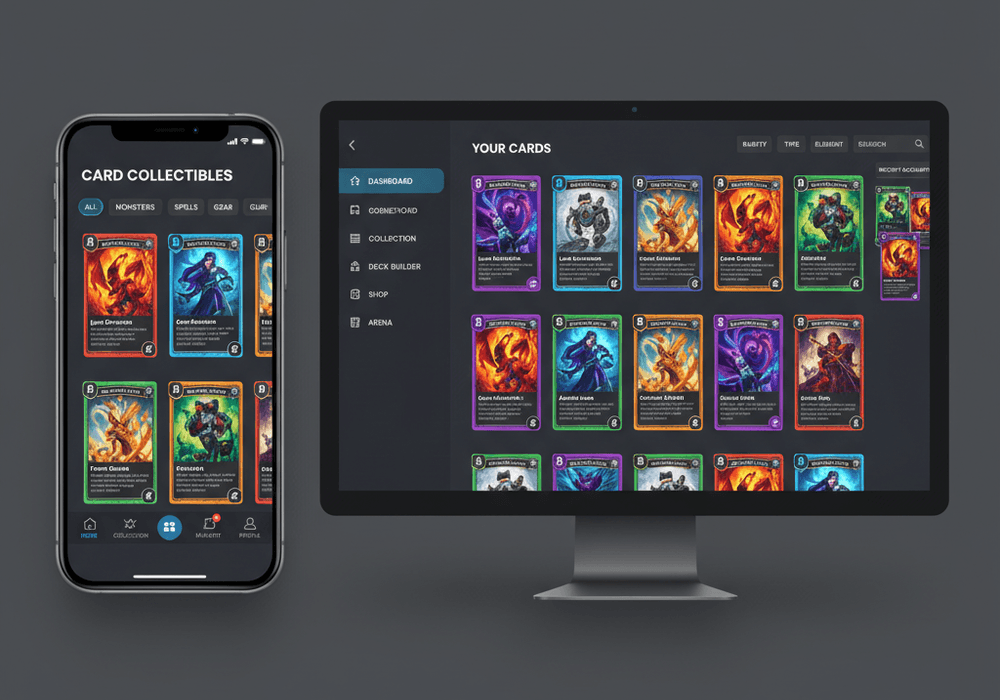
CardForge looks and feels like a video game! We use vibrant colors, smooth animations, and AR effects to make collecting cards exciting. Kids love the animated card flips, while adults appreciate the clean, professional dashboard.
import { useState } from 'react';
import { cn } from '@/lib/utils';

export function FlipCard({ frontImage, backImage, cardName }: FlipCardProps) {
  const [isFlipped, setIsFlipped] = useState(false);

  return (
    <div
      className="relative w-64 h-96 cursor-pointer perspective-1000"
      onClick={() => setIsFlipped(!isFlipped)}
    >
      <div
        className={cn(
          "relative w-full h-full transition-transform duration-700 transform-style-3d",
          isFlipped && "rotate-y-180"
        )}
      >
        {/* Front of card */}
        <div className="absolute w-full h-full backface-hidden">
          <div className="w-full h-full rounded-xl shadow-2xl overflow-hidden border-4 border-primary/50">
            <img
              src={frontImage}
              alt={cardName}
              className="w-full h-full object-cover"
            />
          </div>
        </div>

        {/* Back of card */}
        <div className="absolute w-full h-full backface-hidden rotate-y-180">
          <div className="w-full h-full rounded-xl shadow-2xl overflow-hidden border-4 border-chart-2/50 bg-gradient-to-br from-chart-1 to-chart-2 flex items-center justify-center">
            <img
              src={backImage}
              alt="Card back"
              className="w-full h-full object-cover"
            />
          </div>
        </div>
      </div>
    </div>
  );
}

// Add to tailwind.config.js:
// theme: {
//   extend: {
//     perspective: {
//       '1000': '1000px',
//     },
//     transformStyle: {
//       '3d': 'preserve-3d',
//     },
//     backfaceVisibility: {
//       'hidden': 'hidden',
//     },
//     rotate: {
//       'y-180': 'rotateY(180deg)',
//     },
//   },
// },
Key Features: Game Levels Unlocked!
Think of CardForge features as levels in a game. Each one makes your collecting journey more epic!
🎁 Level 1: Unpacking & Identification
Open a pack, scan each card, and let AI identify it instantly. No more Googling card names!
🔍 Level 2: Grading & Fake Detection
Get a professional-grade score (1-10) and authenticity check in under 60 seconds.
📚 Level 3: Library & Marketplace
Browse your collection in a beautiful gallery. List cards for sale or browse others' listings.
🔄 Level 4: Trading
Propose trades with friends. The blockchain ensures fair, secure swaps.
🏆 Level 5: Tournaments
Enter AR battles and tournaments. Win prizes and climb the leaderboard!
👥 Level 6: Social Features
Follow friends, like collections, and chat with other collectors. Build your squad!
🎴 Level 7: Deck Builder
Create custom decks for battles. Test strategies and share with the community.
🔥 Level 8: Burn-Rate Mechanics
"Burn" duplicate cards to earn CFT tokens. Reduce supply, increase value!
Proofs & Transparency: Trust, But Verify
CardForge uses a multi-tier authentication system to ensure every card is legit:
Tier 1: AI Verification
Our AI scans the card and gives an initial verdict. It's fast and accurate, but not perfect.
Tier 2: Community Witnesses
Experienced collectors can review flagged cards. Think of them as jury members!
Tier 3: On-Chain Verification
All data is stored on the blockchain. Anyone can audit the history of a card.
This triple-layer system means you can trust CardForge, but you can also verify everything yourself. Transparency is our superpower!
Tokenomics: The CFT Token
Meet CFT (CardForge Token), the fuel that powers our ecosystem. Think of it as arcade tokens—you earn them by playing and spend them on cool stuff!
Total Supply
1,000,000,000 CFT
Fixed supply, no inflation
Community Allocation
40%
400M tokens for users
📊 Token Distribution
- 40% - Community rewards (scanning, trading, tournaments)
- 25% - Development & operations
- 20% - Liquidity pools & exchanges
- 10% - Team & advisors (4-year vesting)
- 5% - Marketing & partnerships
🔥 Deflationary Mechanics
When you "burn" duplicate cards, a small amount of CFT is permanently removed from circulation. This makes remaining tokens more valuable over time!
💎 Staking & Rewards
Stake CFT tokens to earn passive income. The longer you stake, the higher your rewards. Plus, stakers get early access to new features!
🎮 Earn CFT By:
- Scanning and verifying cards
- Winning tournaments
- Trading on the marketplace
- Referring friends
- Contributing to community governance
Roadmap: The Quest Ahead
Here's our plan to build the ultimate card-collecting platform. Think of it as a quest map with epic milestones!
Phase 1: MVP Launch
- AI card scanner (iOS & Android)
- Basic grading system
- NFT minting on testnet
- Simple marketplace
Phase 2: Mainnet & Social
- Launch on Ethereum L2 mainnet
- Social features (profiles, follows, likes)
- Trading system
- CFT token launch
Phase 3: Gaming & AR
- AR battle mode
- Tournament system
- Deck builder
- Leaderboards & achievements
Phase 4: Advanced Features
- Multi-chain support (Solana, Polygon)
- Advanced AI (video grading, 3D scans)
- Community governance (DAO)
- Burn-rate mechanics
Phase 5: Open Ecosystem
- Open-source AI models
- Third-party integrations
- Physical card redemption
- Global expansion & partnerships
Risks & Mitigations: Facing the Challenges
Every quest has obstacles. Here's how we're preparing to overcome them:
⚠️ Risk: AI Accuracy
Problem: AI might misidentify rare or unusual cards.
Solution: Continuous training with new data. Community review system for flagged cards. Human experts on standby.
⚠️ Risk: User Adoption
Problem: Collectors might be skeptical of new technology.
Solution: Free tier with no blockchain knowledge required. Partnerships with card shops and influencers. Educational content and tutorials.
⚠️ Risk: Regulatory Uncertainty
Problem: NFT and crypto regulations vary by country.
Solution: Legal team monitoring regulations. Compliance-first approach. Option to use app without crypto features.
⚠️ Risk: Technical Scalability
Problem: Millions of users could overwhelm the system.
Solution: Layer 2 scaling solutions. Cloud infrastructure with auto-scaling. Optimized AI models for mobile devices.
⚠️ Risk: Security Breaches
Problem: Hackers might target user wallets or data.
Solution: Multi-signature wallets. Regular security audits. Bug bounty program. Insurance fund for verified losses.
Conclusion: Join the CardForge Revolution!
CardForge isn't just an app—it's a movement. We're building a world where every card collector, from 8 to 80, can enjoy their hobby with confidence, fairness, and fun. No more fakes, no more waiting, no more boring binders. Just pure, epic card-collecting joy!
Our AI detectives work 24/7 to protect you. Our blockchain treasure chest keeps your cards safe forever. Our gaming platform turns collecting into an adventure. And our community? That's you—the heroes who make CardForge magical.
Why CardForge Will Win:
- ✓Technology: Best-in-class AI and blockchain integration
- ✓User Experience: Fun, beautiful, and accessible to all ages
- ✓Community: Built by collectors, for collectors
- ✓Transparency: Open-source, auditable, trustworthy
- ✓Economics: Sustainable tokenomics with real utility
The future of card collecting is here. It's bright, it's bold, and it's powered by CardForge. Whether you're a Pokémon master, a sports card fanatic, or a Magic: The Gathering wizard, we've got you covered.
Ready to Start Your Quest?
Join thousands of collectors already using CardForge!
"In CardForge, every card has a story. What will yours be?"